AI Won't Fix This. You're Using It Wrong.
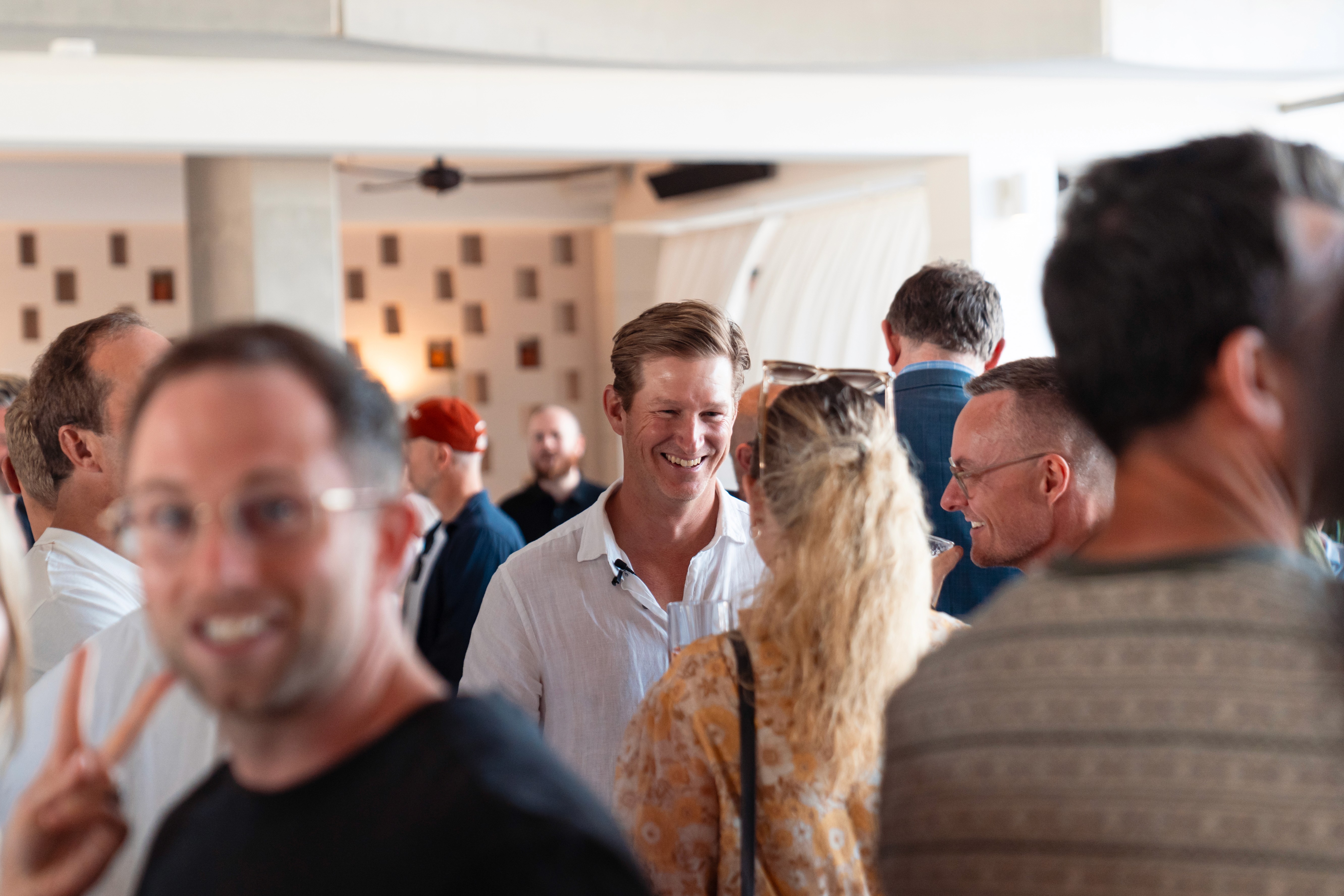
We had 120 people at the Mondrian for Friday @ Mondrian by Currents. Two founders said something at lunch that nobody could unhear. And we used AI to connect every single person in the room. The irony was not lost on anyone.
8 min read
Every founder in that room had a version of this moment. You're mid-conversation, someone says something that cuts through the noise, and the whole room goes quiet.
It happened twice at our Friday @ Mondrian luncheon. Both times, it was about AI. Both times, the person talking was someone you'd least expect to say it.
The second was Natasha Friedman. Registered Nurse. Certified Health Coach. Founder of Cure8 Studio, a longevity clinic on the Gold Coast running IV therapy, hyperbaric oxygen, red light, and ozone therapy. The kind of medical-grade biohacking stack that's been operating in the US and UK for years. She's bringing it here, built it from scratch, and is now expanding to Double Bay in May.
I'd been talking about my own routine before we sat down: 4am wake-ups, blood testing, ice baths, optimising every hour. Health is how I stay sharp. I wanted to hear from someone who's built a business on that same premise.
I asked her the question I've been asking everyone lately. How much time are you actually spending talking to AI versus the people in your life?
She laughed. Then she said this.
She laughed and quoted something she'd seen online: you can look at my phone, my Instagram, my Facebook. Just don't look at my ChatGPT or Claude. Then she paused.
"It's like my psychologist. It's helping me with business. It's helping me on a personal level too." Natasha Friedman, Founder, Cure8 Studio
A nurse. Someone who has spent her career putting the right things into human bodies. Using an AI as her therapist.
Not embarrassed. Not joking. Just honest. Which is the more interesting thing.
AI won't fix what AI is causing.
Here's the tension Tash is sitting inside, and most high-performing founders are too. She knows that AI is making people lonelier. She's watching it happen. And she's also using it daily for some of the most personal conversations in her life.
That's not hypocrisy. That's the honest friction of building in 2026. The tools are genuinely useful. They're also filling gaps that should probably be filled by people.
The US Surgeon General declared loneliness a public health crisis in 2023. The WHO linked social isolation to 871,000 deaths a year globally. A 2025 randomised controlled trial found that the more people relied on AI for emotional support, the less support they received from actual friends and family. The substitution is real and it's measurable.
Tash sees it from the inside. She treats people whose bodies are breaking down from stress, overwork, and disconnection. She's also one of those people. That's not a criticism, it's just the world we're operating in right now.
What she's actually building.
Cure8 Studio's whole model is a rejection of reactive medicine. You wait until you're sick. The GP turns you away. Nothing changes. Tash's answer is to get to the root cause before it becomes a crisis: preventative health, performance optimisation, longevity protocols.
IV drips with NAD+ and essential minerals. Hyperbaric oxygen. Red light therapy. Transdermal ozone. The full stack. Medical-grade equipment most Australians can't easily access anywhere else.
Her investor found her the same way good investors always find the right founders. He was a client first. He came in for IV therapy, watched her work, had a space, and said bring your vision here. She pitched the full biohacking clinic concept and he backed it. Now they're taking it to Sydney.
Her read on Double Bay: high-stress entrepreneurs, office workers, no one doing what she does at this level. She was getting inbound from Sydney asking if she knew anywhere. She decided to go herself.
AI in the back end. Humans at the front.
When I asked her about AI in the business, her answer was precise. Operations and back end: yes, implement it everywhere you can. Client communication: no. That stays human.
She put it simply: "I know my lawyer uses AI. But I do business with him because of the person."
Nobody books a longevity consultation because the intake process was slick. They come back because they trust the person who sat across from them and actually listened. That part doesn't automate.
This is the thing most founders get wrong when they talk about AI replacing jobs. It doesn't replace the human element. It highlights how valuable the human element actually is. The more AI handles, the more premium real attention becomes.
The correction is coming.
I said it at the end of the interview. My read is that people are going deep into AI dependency right now, and we'll swing back.
"People are going to go off it a little bit and actually focus on being more human." Wade Foxx
Tash agreed. And she said it the way a nurse who's watched patients ignore symptoms would say it. The correction always comes. You can substitute for a while. Eventually the real thing becomes urgent.
We ran AI matching for 100 people that afternoon, algorithmically pairing every attendee with two curated connections before they walked in the door. The tool in service of the human moment. That's the right order of operations.
The irony of the day was doing a lot of work. We used AI to get 100 people into better conversations with each other. Tash admitted she uses AI as her psychologist. Two things that are both true. The question isn't whether to use the tools. It's whether you're using them to avoid the thing they should be helping you get to.
Why Tash is exactly who Currents exists for.
She's not talking about innovation in the abstract. She's a founder who saw a broken system, trained in it for years, and decided to build the alternative. She's using AI where it works and protecting the parts where it doesn't. She's expanding because the market is pulling her, not because she raised a round and needs to deploy capital.
That's the kind of building that actually compounds.
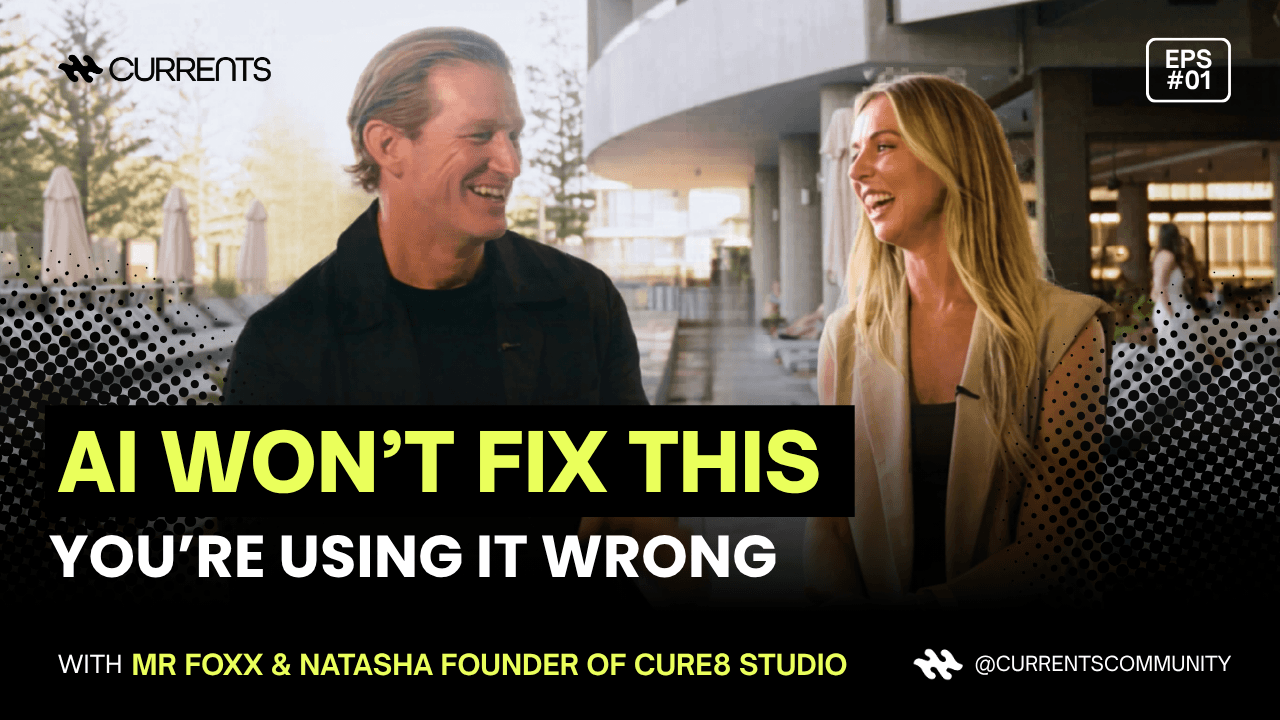
Watch the full conversation on YouTube: AI Won't Fix This: Ep. 01 with Natasha Friedman →
Follow Tash and Cure8 Studio: @tashfriedman. If you're building something real and tired of building it alone, see what's on at Currents →
Tash is offering Currents members 20% off until end of May 2026. Use code CURRENTS20 at cure8studio.com.au. IV therapy, hyperbaric oxygen, red light, ozone. The full stack.