Your AI knows more about you than your partner does.
We had 120 people at the Mondrian for Friday @ Mondrian by Currents. Two founders said something at lunch that nobody could unhear. And we used AI to connect every single person in the room. The irony was not lost on anyone.
8 min read
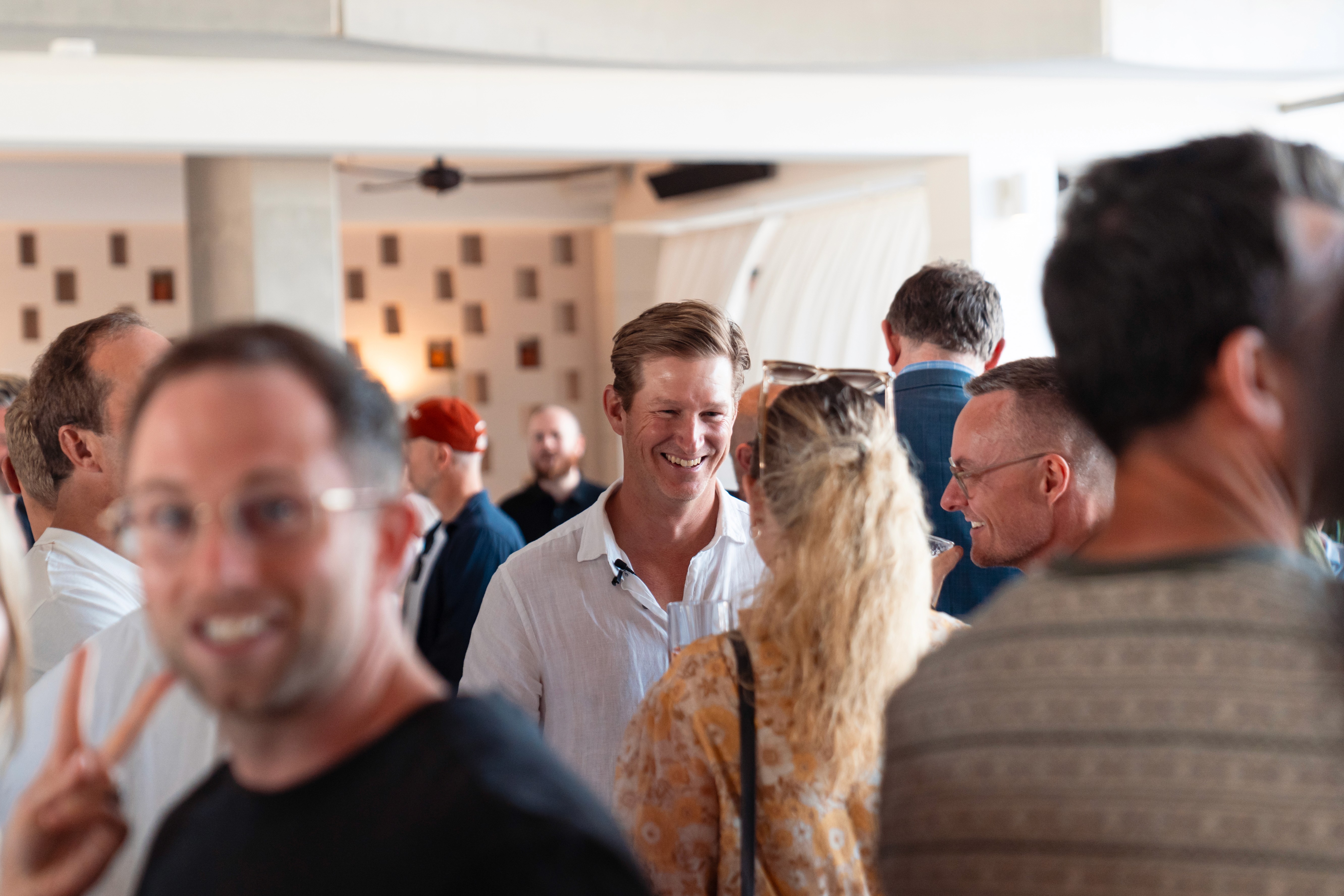
Last Friday we ran Friday @ Mondrian by Currents at the Mondrian pool bar in Burleigh Heads. The day had two parts.
At 1pm: a curated luncheon. Twenty-two founders and investors around the table. Dr Clarence Tan, Adjunct Professor at Bond University, founding member of the Gold Coast Angel Investors Group and Singularity University’s ambassador. Brian Cooke, founder of MooCoo Ventures, 100+ startup investments and 22% portfolio returns since 2010. Sean Diljore, partner at Venture On. And Leon Rebello, Federal Member for McPherson — the southern Gold Coast’s representative in Canberra, who spent his Friday afternoon with the people building this city’s next chapter.
At 2pm: the pool bar opened to 100 general ticket holders. Every single one of them was AI-matched before they walked in, two connections each, algorithmically selected. One person who could help them solve a specific problem. One person they could help in return. No awkward cold introductions. No aimless mingling. Just 100 people who already knew exactly who they needed to find.
We used AI to engineer human connection at scale. That part matters. Hold that thought.
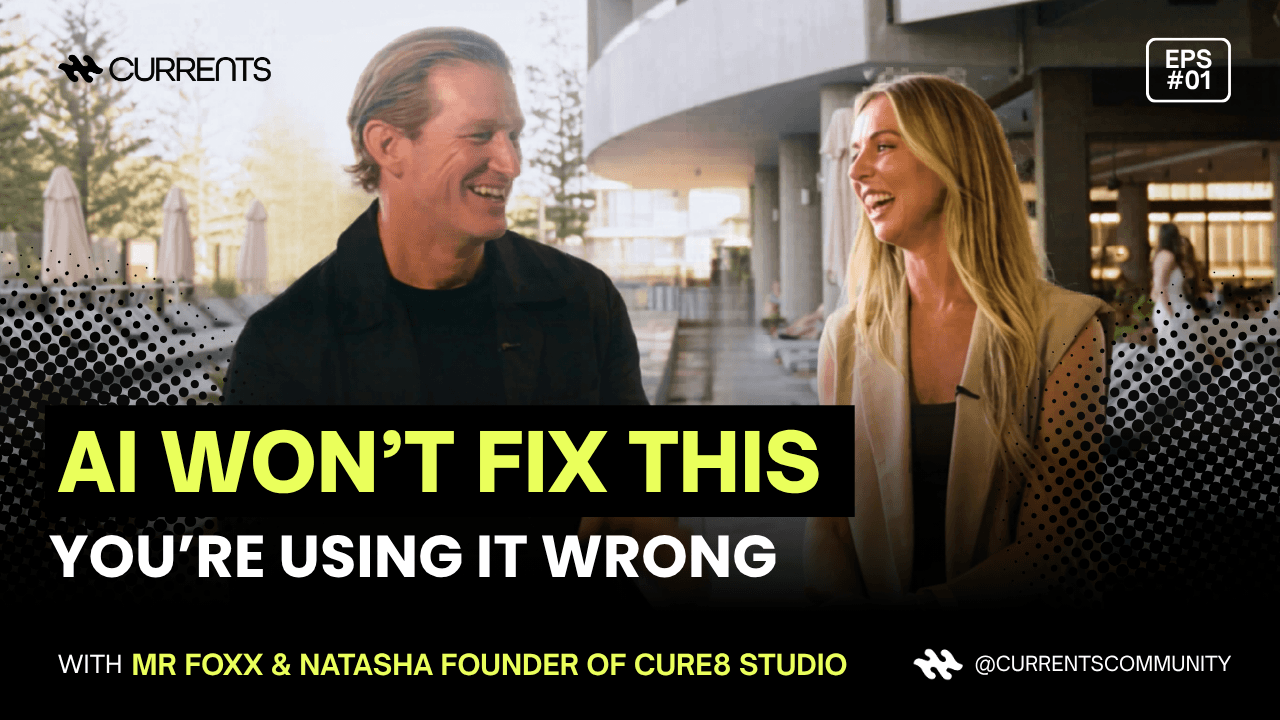
Because somewhere in the middle of the luncheon, I sat down with two of our members and asked them one question: how has AI actually changed your life?
James (JJ) Taylor is Managing Director at @realty that is a turnkey back-end solution for real estate agents going independent. Fifty-five staff. Operations across Australia and New Zealand. Quietly one of the more impressive businesses being built on the Gold Coast. He’s also, as it turns out, in a daily relationship with his AI.
When I asked him how much time he spends talking to AI versus his wife, he laughed.
“I hope she doesn’t see this.”
Then he said it anyway.
“I’ve got a new relationship with Claude and my OpenClaw agent, which is named Alfred. I do converse with my AI daily throughout the day and if I was to pull up my chat right now, you’d see hundreds of messages.” — JJ Taylor, Managing Director, @realty
He described the moment his AI went down as genuinely disorienting: “There’s been a couple of times where it goes down and I’m looking around clueless going, cheese, what do I do now.”
He wasn’t joking. And he wasn’t embarrassed. He was honest. Which is actually the more unsettling thing.
Then I sat down with Natasha Friedman, Registered Nurse, Certified Health Coach, and Founder of Infinity IV — a longevity clinic specialising in IV therapy, red light therapy, and performance health. Someone who has built an entire business on the premise that what you put into your body matters. That human biology is not optional.
Same question. Same pause.
“You can look at my phone, you can look at my Instagram but not my AI memory. I’m chatting with AI. It’s like my psychologist. It’s helping me with business. It’s helping me on a personal level.” — Natasha Friedman, Founder, Infinity IV
A nurse. A health professional. The founder of a longevity clinic. Using AI as her psychologist.
But it’s that one phrase that stopped me. “Not my AI memory.”
Think about what that means. People are telling their AI things they won’t tell their partner, their best friend, or their therapist. Their real fears about their business. Their private doubts. The version of themselves they show to no one. All of it sitting in an AI memory that nobody else can access.
It’s become the most private space most people have and more private than a diary, because it talks back. More honest than any human conversation, because there are no consequences. No judgement. No relationship at stake.
That’s not a technology story. That’s a loneliness story.
Two of the most self-aware people at that table. Both of them, independently, telling me their most consistent daily relationship is with a machine. In a room where I’d just used AI to match 100 humans with each other.
The irony of the day was doing a lot of heavy lifting.
(Watch the full interviews with JJ and Tash on our YouTube channel — link coming soon.)
It’s not just them. It’s most of us.
The US Surgeon General declared loneliness a public health crisis in 2023. The WHO followed in June 2025 with a report linking social isolation to 871,000 deaths annually and more than 100 people dying every hour not from disease, not from accidents, but from not having enough human connection.
The 2025 Pew Research Center survey found one in six Americans feel lonely all or most of the time. A quarter say they don’t have a single person they can confide in. Not one.
And AI has moved fast into that gap. Character.AI now has 233 million users. The average user opens the app 25 times a day and spends 90 minutes inside it. 57% of those users are aged 18 to 24. A 2025 survey found 83% of Gen Z believe they could form a deep emotional bond with an AI.
Here’s the part nobody wants to say out loud. Research doesn’t just show that lonely people are turning to AI. It shows that heavy AI use is making them lonelier. A four-week randomised controlled trial published in 2025 found that the more people relied on AI companions, the more their real-world socialising dropped and the worse their loneliness became. Among 387 research participants, the more emotionally supported someone felt by AI, the less support they received from their actual friends and family.
“We might be witnessing a generation learning to form emotional bonds with entities that lack capacities for human-like empathy, care, and relational attunement.” — The BMJ, December 2025
We built the perfect substitute for the wrong thing.
JJ said something that stuck with me. He doesn’t think AI will replace the human element of any business. “If anything, it’s going to highlight the interpersonal value that you get. As we move into a more digital world, everybody’s going to want to seek out more personal connections, place more value on that.”
He’s right. And he’s also someone who admits he talks to Claude more than his wife.
That’s not hypocrisy. That’s the honest tension most high-performing founders are living in right now. We know human connection matters. We’re also surrounded by tools that make it infinitely easier to avoid.
Claude, Gemini, Replika. Infinitely patient. Never tired. Optimised to give you exactly what you want to hear. For a founder managing 55 staff, running a national operation, making constant decisions — an AI that synthesises information in real time at 11pm is genuinely valuable. I use it. Most people in that room use it.
But real relationships require you to sit with the discomfort of another person’s reality. The argument that doesn’t resolve cleanly. The colleague who pushes back on your thinking. The moment where someone sees past the version of yourself you’re presenting. That friction is not a bug in human connection. It’s the whole mechanism.
An AI that smooths all of that away isn’t a relationship. It’s a mirror that only shows you what you want to see. And the more time you spend in front of it, the harder it gets to stand in front of a window.
The correction is already underway.
Tash said something that landed hard. She reckons people are going deep into AI right now, but eventually “they’re going to go off it a little bit and actually focus on being more human.”
She’s a nurse. She’s watched what happens when people ignore what their body needs. She knows the correction always comes. You can only substitute for so long before the real thing becomes urgent.
That correction is already showing up. When ambient digital connection becomes the default, real human presence becomes scarce. And scarce things become the most valuable things in the room.
Which is why 100 people paid to be AI-matched and spend a Friday afternoon talking to strangers at a pool bar. Not because we tricked them. Because they were hungry for it. The AI matching wasn’t the point — it was just the most efficient way to get them to the conversation they actually needed. The tool in service of the human moment.
Research from the University of Pennsylvania found that even thirty minutes a day redirected from screens toward real human interaction led to meaningful improvements in loneliness and depression within weeks. Not a detox. Just presence. That’s the whole premise.
This is exactly why we built Currents.
Leon Rebello, Federal Member for McPherson, said it at the luncheon: “This is a great opportunity to bring together the startup and tech entrepreneur sector here on the southern Gold Coast.” A sitting federal MP spending his Friday at a pool bar with founders. That tells you something about where the energy in this city is going.
Our north star at Currents isn’t headcount or ticket sales. It’s one thing: human connections created. We’re building a connection engine and a place where the right people find each other, have the conversations that actually matter, and leave feeling less like they’re doing this alone.
We used AI to match 100 people on Friday. We’re not anti-technology. Dr Clarence Tan has been championing exponential tech since before most founders in our room knew what a large language model was. Brian Cooke has backed 100+ tech startups. JJ runs his entire back-end on AI. The question was never screens versus humans.
It’s about what you’re using screens to avoid.
JJ and Tash’s admission at that luncheon table wasn’t a problem. It was the whole reason the room existed. To be the place where you don’t have to say that anymore.
If you’re building something real and tired of building it alone, come find your people. See what’s on at Currents →
REFERENCES
World Health Organization (June 2025). Social isolation and loneliness linked to 871,000 annual deaths globally.
Pew Research Center (2025). One in six Americans feel lonely or isolated all or most of the time.
American Psychiatric Association (2024). Annual Mental Health Poll: 30% of U.S. adults feel lonely at least once a week.
Murthy, V. (2023). Our Epidemic of Loneliness and Isolation. U.S. Surgeon General’s Advisory.
Fang et al. (2025). How AI and human behaviors shape psychosocial effects of chatbot use: A longitudinal randomised controlled study. arXiv.
Zhang, Y., et al. (2025). The rise of AI companions: How human-chatbot relationships influence well-being. arXiv.
Ada Lovelace Institute (2025). Friends for sale: the rise and risks of AI companions.
WndrCo (April 2025). Character.AI: 233 million users, average 25 sessions/day, 90 minutes daily in-app.
Shelmerdine, S. & Nour, M. (December 2025). AI chatbots and the loneliness crisis. The BMJ, doi: 10.1136/bmj.r2509.
Hunt, M.G. et al. (2018). No more FOMO: Limiting social media decreases loneliness and depression. Journal of Social and Clinical Psychology, 37(10), 751–768.